Travel . . . Passport to Our World

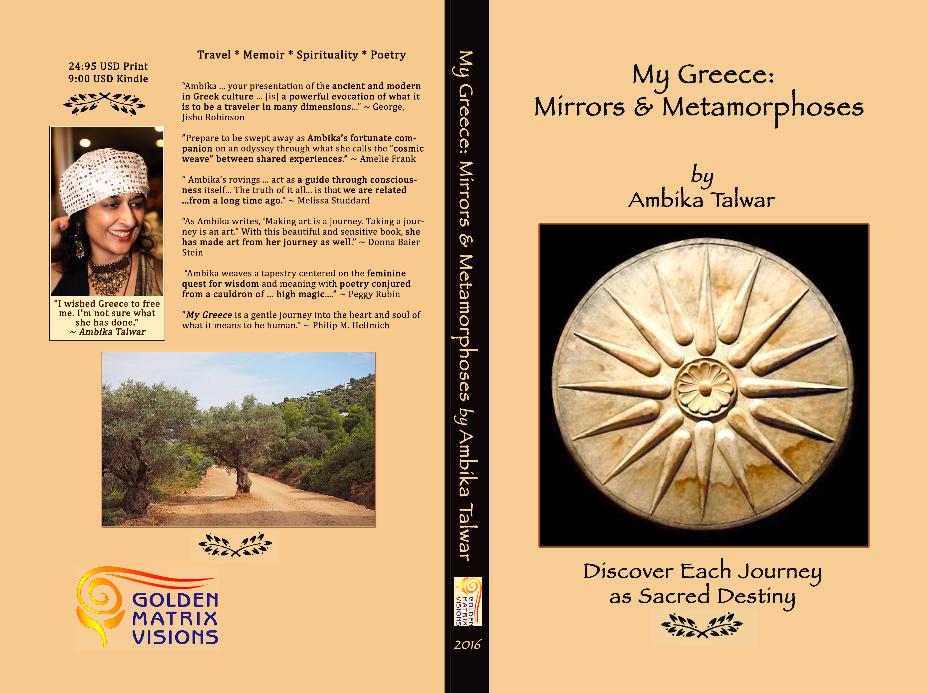
Interview with Ambika Talwar
on her book,
My Greece: Mirrors & Metamorphoses
ICM: What was the inspiration behind your book, My Greece: Mirrors & Metamorphoses?
Ambika Talwar: I had been thinking of a story I wanted to write set some place with lots of butterflies. I had an outline ready. And out of the blue, someone sent me info on a screenwriting workshop with a group traveling to Greece … I had made a film in 2000 titled Androgyne. Somehow it all seemed to be connected. So I jumped on it. And Greece, this ancient land of myth and shadows, tugged. Who would want to turn away an opportunity to visit this old land!
Someone suggested I would love being in Paros to write this new story … but I never made it there. Yes, the Island of Rhodes is known for its butterflies – have not been there either.
We are raised on stories of how we came to be and what becomes to and of us as we journey. I was curious to visit a place whose mythology I had read while growing up in India, also ancient. And I kind of missed such elements here in Los Angeles. So things move too quickly here… I missed a sense of layered tones.
So as I traveled with my big PD 150 Sony camera and a notebook, I recorded my experiences. These included meetings with people, traveling between ruins, cafes, old and new parts of old cities. And I was both enchanted and deeply sadly disturbed. It made me realize how much we have lost over time and with rapid industrialization and how fragmented we are in so many ways … well, as if neuroses were always the fuel. Should it not be beauty, grace, and the play of wisdom…?
Does this make sense? I wanted to record and share the narrative of my experiences, which gave rise to other narratives and poems. These I feel … reflect to me the richness of each moment alively tuning us in.
And on another level, I just wanted to tell this story of my time there.
ICM: Why is this book important to your audience?
Ambika Talwar: Let me reframe this. What I wish people to get out of this book, which has taken me so long to complete, is simply an understanding that every single moment of our lives is a journey and a destiny and a purpose. That a story, a name, a metaphor can reveal ways for us to find simplicity in our lives.
I wish people find their story in these moments that are poetic narratives of longing, of isolation, of union … of desires and create ways to find this… And, I warn you, in moments the stories run very fast. This is a caution to me as well. We need to let go of so much, to be whole.
ICM: What might I glean from the book?
Ambika Talwar: I’d say this is best left to the individual reader. What is your particular, unique essence that responds to my story and poems? This is where you would find yourself.
ICM: What do “Mirrors and Metamorphoses” have to do with Greece?
Ambika Talwar: Well, one can’t travel somewhere and not see the rich fare offered … foods, but sensibility, mythological framework, syncretistic connections … something gained, something lost. It’s as if our layered skins take on whole new identities and just when we start to know ourselves, something else rushes in to claim us – leading to distortions, sorrow, loss, chaos, and then must follow a renewing of faith in ourselves.
So in this context… I had titled my book My Greece: Mirrors, Metaphors, and Metamorphoses, but found “metaphors” redundant. “Mirrors” said it all for me. So really, the stories reflect how we are mirrored and how we are changed by one another.
Meetings with people and places offered motifs to remind me of things forgotten or of the mysterious. Everywhere I went, people would welcome me saying, “You are Indian. We are cousins.” And indeed we are cousins. We are all related. So we share mirrored realities, be it in story, art, mythology, music … and our deep human longing.
What is our sacred destiny? What do we wish now to mirror? How shall we transform together? Isn’t it this – to discover all our moments as sacred?
ICM: How can I use this book to apply it to my life? Is there a strategy? Is it a fun read or is it a transformational book?
Ambika Talwar: No, it is not a how-to book, but it invites you to travel with me, experience my stories, ask questions about who we are, and wonder where we are going. We may be transformed by various influences; this is your call.
Perhaps, aspects of my story might inspire you to be more yourself… whatever that is. I would wish that my readers and, maybe you, are inspired to see yourself as part of all that is … our inherent unities. This, I feel, ought to be the foundation of our human culture from now on. And if this is an offering of “feminine magic,” as one of my reviewers said, so be it. I like it. It surely is time for us all to reach out to each other so we may stand in wholeness.
Yes and re-discover our human heart and its capacity. It’s tough to break out of conditioning.
ICM: Is it a story or narrative in which I will get lost?
Ambika Talwar: It is a narrative with smaller narratives enlivening the tale. You can either get lost in it or find yourself… and this, too, is a journey. You choose.
ICM: So there was a gap in your writing of it. What compelled you to finish it?
Ambika Talwar: I could not rest with myself, had I discarded it. My initial very rough draft sat for a bit. For many reasons I could not get to it. Traveling, teaching, recovering from injury caused delays. I had to get it done. And in 2014 I picked it up again. So here we are.
I have to say, I am quite a romantic at heart. This book has been a bit of a strange love affair. Meetings with filmmaker Theo Angelopoulos was surely exciting; experiencing the underworld through being robbed left me vulnerable but I handled it quite well; not visiting the rock in Tinos shattered me; dancing at the Plaka was sweet swimming in the Mediterranean was pure joy; listening to the Roma boys sing was enchanting. And, learning to say “Yes” which sounded like a “No” and created confusion… all this was play. All these moments mattered. I did not want to forget them. We are all related.
Also, before I traveled to Greece, I had met many Greeks here in LA. I took some classes in Sirtaki, ate Greek food, went to a few parties… it is again synchronistic that this opportunity showed up when it did. I was being prepared for the journey.
I am grateful that we are enriched not by the samification of our cultures but by each particular uniqueness.
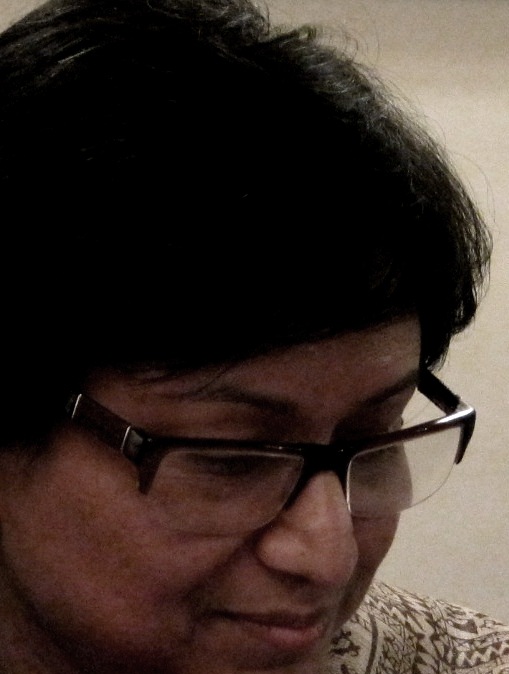
Nilanjana Bose is a market researcher and a bi-lingual writer. She has published a collection of short fiction, and is working on her second book. Her pieces have also been published in Anandalipi, a US based journal. She is from India, but has lived and worked in various locations in the Middle East and Africa, as well as traveling beyond.

Leaves
of a
Thousand Flowers
Before the beginning of years
There came to the making of man
Time, with a gift of tears;
Grief, with a glass that ran...
~ Algernon Charles Swinburne.
“Is the brother Bengali?” Ooh, a definite kick to being addressed in your own language when you are far from home, both the homeland and the expat hearth, the cadence of the accent an extra bonus. The voice carries to us as we stand talking amongst ourselves about the best way forward. It is one of the hawkers laying out his wares beyond the reach of the sea.
“Yes, brother. And you?” My husband and I move closer to his display.
“From Bangladesh, you from India, right? Just take this way and go onto San Zaccaria, and get the 41. Season time you’d have got a free taxi, but now I’m not so sure – ”
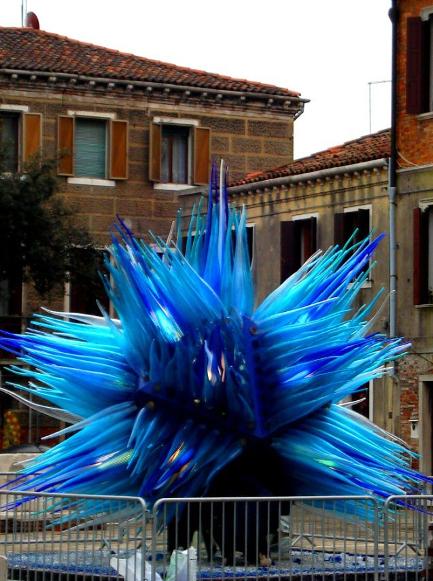
It is a crisp, cold morning at St Marks Square in Venice, flooded with the early milky light, and with a film of tidewaters underfoot. There are wooden benches everywhere formed into walkways, fitted into each other like a crossword puzzle without the words, to keep pedestrian feet dry. We follow the hawker’s instructions, and sure enough even in the Christmas week there is a free ride on a water-taxi. First the sea flares open in shades of grey green, and then again narrows into a canal; the overhang of houses the color of iced cupcakes, vaguely reflected in the waters.
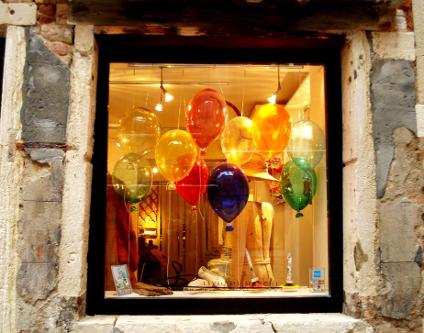
The pier leads to narrow alleys lined with shop windows, and signage silently declaiming the names of studios with a small flourish. We are welcomed into one of them behind the unobtrusive façade - the guide weaves in the story with the walkabout - how the business came to be located here in this tiny island off Venice, and the traditions passed from one generation to the next, unchanged for a thousand years. There are rows and rows of fine art objects and everyday ones; plain, and the starburst of colors called “millefiori” – thousand flowers from the Italian mille and fiori – items sculpted as high as a man and as little as my fingertip. Beyond the jaw-dropping displays, tucked away in the back, is the workshop. The lamp-worker there holds a fiery blob at the end of the pipe and plucks at it with his tongs a few times in what looks like a random manner, twirling and turning the incandescent mass, and in a few minutes, probably about the time it takes to think through and write out this ridiculously long sentence, he sets a perfectly formed, tiny vase down. The color becomes clear once it cools, a rich jeweled blue-green.
“Glass,” the guide shrugs and smiles, “is just amazing. Beautiful. Practical. Strong and fragile at the same time. Nothing else in the world like it.”
Before the beginning of years
Glass, like pottery, is really one of the oldest materials around - the earliest batches the historians have so far are dated to mid-4th millennium BCE. To appreciate the evidence, it is necessary to understand that glass is made in two different stages. The ingot, which is the base material, is cast in crucibles in high temperature furnaces. These are then taken up and worked into different items by glass workshops/studios. However, while evidence of workshops is available till pretty far back, that relating to the furnaces and casting isn’t as fleshed out as our understanding of the former.
Archeological data points to the very first glass being made about the same time in the north coast of Syria, Mesopotamia and/or ancient Egypt, perhaps accidentally as a byproduct of making faience or other ceramic material. The earliest end products were beads, and those remained a luxury item restricted in reach to the incumbent movers and shakers locally. Egypt forms an ideal archive of historical artifacts due to the climate; much of that ancient glassmaking/working process debris is found in the ruins of settlements like Amarna and Piramesses. Obsidian, a naturally formed glass as volcanic lava cools, has been known from Stone Age, and its cutting properties employed in sharp tools by knapping. Both obsidian and glass were rarities of high value and so obviously traded across societies. A shipwreck that happened around 1306 BCE off the coastline of Turkey carried, among many other things, colored glass ingots thought to be made in Mesopotamia. By that time, a couple of millennia after the first glass beads, artisans were producing glass vessels in the workshops.
Glassmaking recipes were compiled into tablets by 650 BCE, kept in the library of King Assurbanipal of Assyria. Around 250 BCE glass workers discovered that glass can be blown into hollow shapes, this was a landmark in glass technology, as prior to this glass vessels were made by quite different methods – molding around a baked clay core, and/or by cold grinding and polishing, all of them time- and labor-intensive. Blowing made large scale, much quicker production of hollow vessels possible, popularizing and spreading the use of glass.
Phoenicians picked up the technology from the eastern
shores of the Mediterranean and carried it westwards to Carthage where they made the first glass art
and traded glass products, both art and utility items, up and down the entire
sea coast. The Phoenicians fell to the
Roman Empire, and so Rome
took up where the Phoenicians left off as the last centuries of the 1st
millennium BCE closed. As the Roman empire annexed ever larger swathes of lands east
and west, the population of the Roman cities increased; standards of living
skyrocketed, definitions of luxury changed.
Glass with its fairly wide, and ever-expanding, canvas of possibilities,
slotted right into the picture.
continued . . .
The first use of glass was in windows for the Roman bathhouse in the 1st century BCE. These were cast and ground slabs, for protection and light rather than viewing, so the transparency did not matter. From there window applications developed into stained/colored glass by the 5th century CE, and then stained glass windows evolved into an artform in their own right in medieval Renaissance Europe.
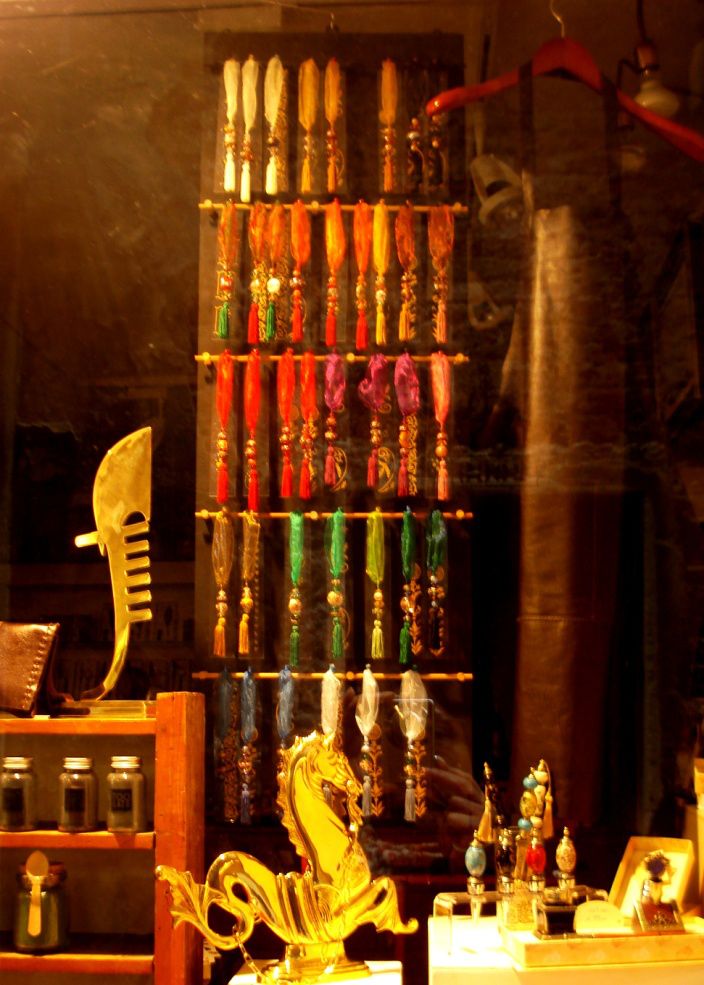
Glass was a practical material in that it did not impart its own smell or taste to things that it contained, therefore ideal for use as dining and drinking utensils, storing medicines and perfumes. Not only was glass inert, it was also transparent and showed its contents clearly, a decided advantage for a society where literacy was limited only to the elite. The base material was relatively cheap compared to precious stones and metals. But it was also easily adaptable; it could be colored and worked into more luxurious, exclusive forms, fashionable at the imperial court, flaunted by emperors as status symbols.
And so glassmaking flourished under the Romans and the use of glass items spread all through the Empire. The Roman artisans developed both intensely colored glass, as well as the colorless “aqua” variety, and Alexandria, the second city of Roman Empire, came to be established as a major glass center by the 1st century. Mosaic glass, the first millefiori, the earliest bud of the thousand flowers, was developed here in the Alexandrian workshops.
The Roman Empire declined 5th century onwards, Alexandria witnessed terrible conflicts, religious tensions and unrest; its legendary library was sacked and burnt, prominent groups of citizens massacred, its beautiful architecture defaced. The city finally fell to the Muslim conquest in 641. Thus the Arabs inherited an established tradition of glass and glassmaking continued to develop in new and myriad directions under the flowering of the new Islamic culture. Abu Musa Jabir ibn Hayyan, a Persian polymath and renowned alchemist, compiled many of his own recipes for different colored glasses in his 8th century Arabic treatise Kitab al-Durra al Maknuna.
Glassmakers to the World
On the other shore of the Mediterranean, in the sunset years of the Roman Empire, refugees fled from the undefended countryside around the major cities as waves of invaders attacked and chipped away at the empire. They came to settle in the marshlands north-east along a large lagoon opening into the Adriatic, sparsely populated by small hamlets of fisher-folk. From those beginnings Venice grew to a powerful republic, a strategic port for commerce, which formed a trade and cultural bridge between the East and West. It also grew to be the prime glassmaking capital, enjoying a near monopoly on glass products for centuries together in Renaissance Europe and the rest of the world.
There is archeological proof of glass making in and around the Venetian lagoon from the 6th century onwards, mostly the tesserae used for mosaics. But the earliest documented record of Venetian glass dates back to 982, and lists one Dominicus Phiolarius, Dominic the maker of phials and bottles. Another record further on in 1082 mentions a maker of flacons, Petrus Flabianicus. However, glass making in the early years remained limited in scope and geographical spread. Small amounts of Venetian glass were made to cater to mostly local demand. .
Glassmaking skills were essentially a Middle Eastern import into the Roman Empire, which then were adapted locally. With the fall of Constantinople in the fourth Crusade in 1204, fleeing populations came into Venice with the techniques and recipes of Islamic glass, like those that had been written in the Kitab al-Durra al-Maknuna in the 8th century and had been developed and refined further in the subsequent centuries. This influx of new expertise completely changed the face of the Venetian industry. By the end of the century, Venetian artisans had assimilated the new skills and created unique products and processes.
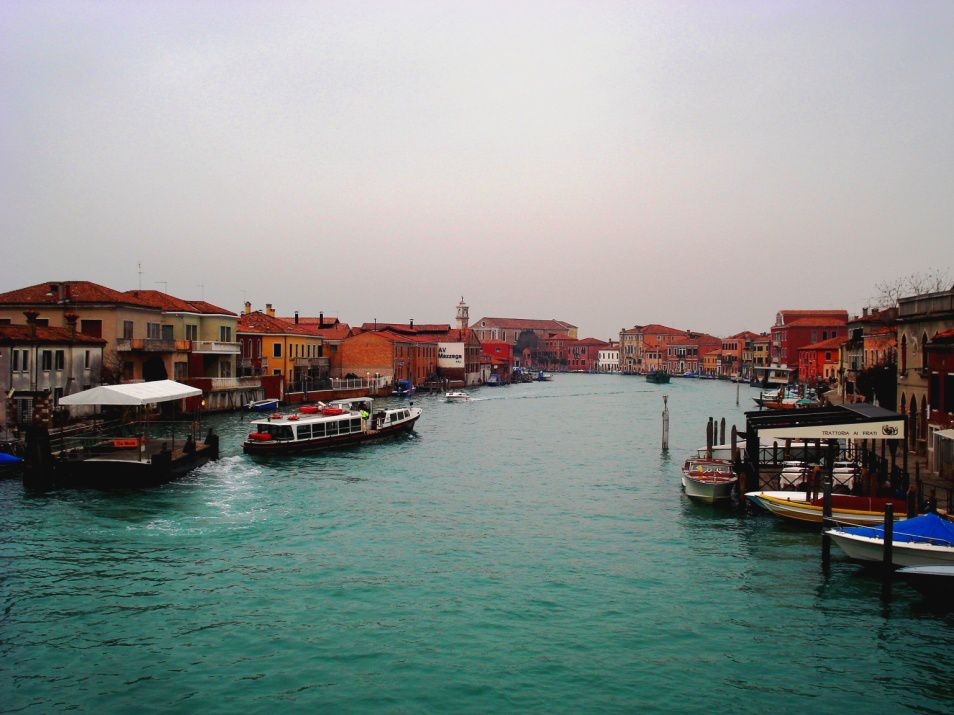
An edict was drawn up in 1271 to regulate both trade and manufacture. From that point onwards, foreigners were prohibited to work glass in Venice, and imports of glass from outside was banned. Local Venetian glassmakers were forbidden to divulge any of the technical secrets outside their guild, travel was disallowed, protection of the process skills given utmost importance. Another twenty years on, the small glass workshops that were scattered all over Venice’s islands, were moved lock, stock and barrel to Murano, ostensibly to avoid the fire hazard they posed to the wooden buildings, but also to further isolate the glassmakers from prying eyes.
Rising on rediscovery
Over the next 500 years, trade agreements, raw material agreements, legislation covering all aspects of production, sale and taxation were drawn up. This single minded focus on the part of the rulers would ensure Venice’s position as the very top glassmaker to European royalty and clergy. The technique of murrine glass and millefiori which had been lost for a thousand years, was rediscovered and taken to imposing heights again.
At the beginning of the 15th century, Murano housed some 3000 glass craftspeople, masters and artists renowned for their glass skills. In 1400, Damascus fell to the Ottomans and passed into Muslim rule, followed by Constantinople in 1453. Further waves of glassmakers came into Venice as a result. With them came in the technique of enamel and gilding of glass. Mid century, a glassmaker called Angelo Barovier produced the Venetian crystal glass, a glass of extremely high clarity which could be cut and polished to a level of hitherto unparalleled perfection. A whole range of stemware and hollow-ware of great lightness, clarity, and elegant, refined designs became possible.
Technical achievements in Venice were matched by other developments in trade and commerce elsewhere in the world - sea-routes to the east were opened up by the Portuguese and the Dutch, America was discovered by Christopher Columbus, opening up further markets for European goods. Africa was explored, where the first explorers landed with Venetian glass beads in their pockets, to entice the local populations and to barter with the tribesmen. Unprecedented quantities of beads of all varieties were produced for this purpose.
But the Venetian monopoly was rendered as fragile as the glass the master craftsmen made by its own technical perfection. Demand for the glassware rose so high that craftsmen started migrating away from Murano to meet it. One such master craftsman went to Tudor England in the 16th century and became glassmaker to Queen Elizabeth I. Venetian merchants set up glassworks elsewhere in Europe, run by Muranese expats, to produce Venetian style glass. Over the years these inducted local workers and so spread the glassworking skills into non-Muranese populations.
In the 17th century a plague epidemic swept through Venice and killed many thousands of people, and changed not only the glass industry but also lace, shipbuilding, and the entire politics of the Venetian Republic. Venice declined, and the course of its industries was changed forever. But the artistic and technical skills remained, in a handful of old glassworks, which still operate today across a span of 700 years! The master craftsmen there still fashion breathtakingly beautiful designs on objects as sheer as water. In the 19th century, fresh investments and a modern day influx of artistic and entrepreneurial skills boosted the industry back into glory days again. Venice still remains synonymous with premium glass, but now faces competition from cheaper imitations made in China and elsewhere.
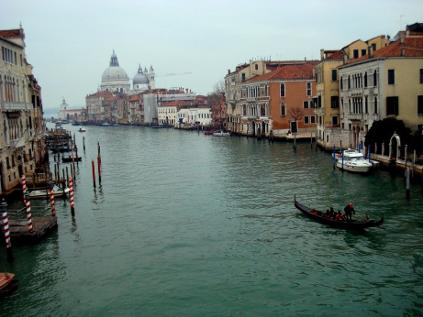
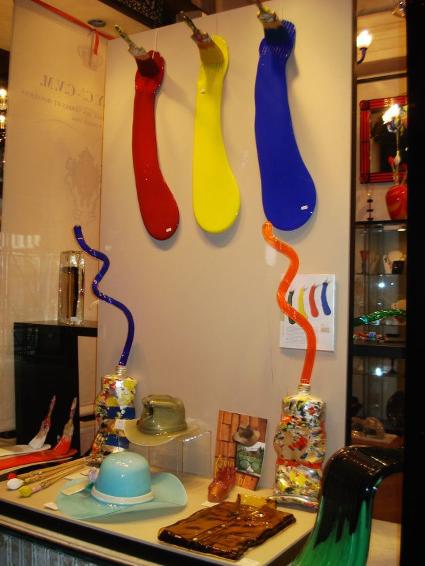
The salesman-cum-guide draws us back again to the showroom and walks us around, there are no free taxi-rides, even in a paradise as charming as Venice. But there is no hard sell, the sales pitch is refined, very gently steeped in nostalgia and history, as delicate as a thousand flowers that give the glass its name. I see the millefiori on display with a newly minted perspective. We debate over the choice of souvenirs – as always desire outstrips ability, the family talk among themselves over a pair of gleaming, exquisitely made horses. I stand apart from father and child, looking at beautiful glass art vases I yearn to possess but know I cannot. Precious, fragile and heavy don’t go well with traveling light.
“How long have you been here?” I ask the guide casually, to take my mind off hankering for things I can’t have.
“All my life,” he answers. “My whole life.”
01 Barefoot on The Beach.mp3
For more information on becoming a Sponsor or Advertising with us at Inner Child Magazine
click HERE